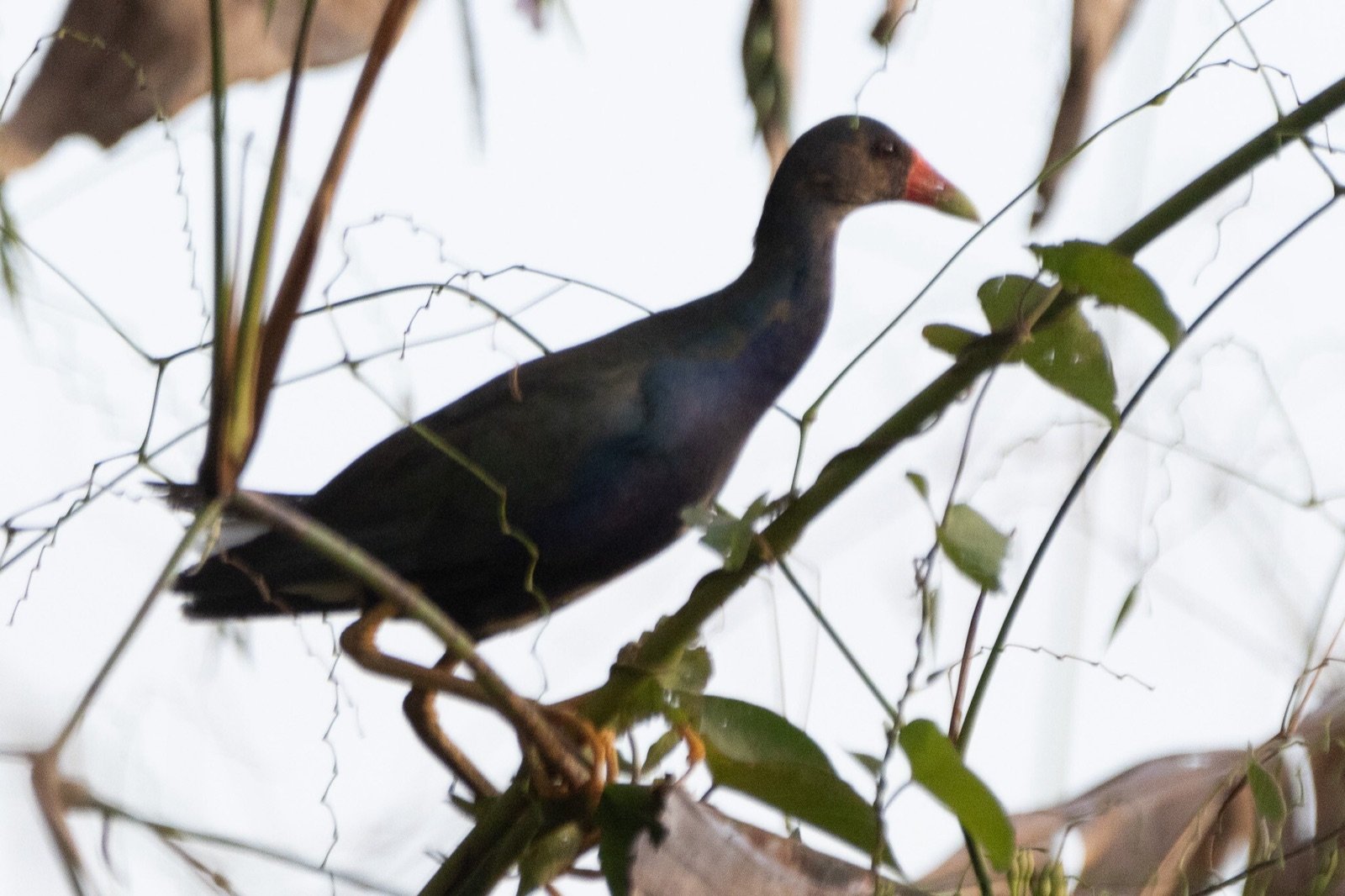
Family Rallidae
Purple Gallinule
Porphyrio martinica
In Spanish: Gallareta Morada (Polla de Agua, Gallina de Agua, Calamón Morada)
- Resident
Violet-blue marsh walker of lily-pad lagoons, best met by boat
The Purple Gallinule is a bird of marshes and wet places, and in Costa Rica it is a resident wherever the habitat suits it. It walks across floating plants on very long toes, which makes a lily-pad lagoon the place to look for it.
On a trip we build to the northern wetlands, guests meet it from a boat drifting quietly through channels that open onto lily-pad lagoons and flooded forest, where it is a listed signature species. A boatman who knows the marsh makes all the difference.
Below you will find how to recognise it, when the water suits it and where to look.
How to find it
Look in dense freshwater wetlands with floating plants such as water lilies and water hyacinth. It is fairly easy to see when walking on floating plants, and harder to see in tall rice stalks. The usual way to bird the northern wetlands is by boat, with guides drifting quietly through the channels to the lily-pad lagoons. A tour boatman at the Medio Queso marsh knew where to find it, and the group saw several birds. Flooded rice paddies are another place to look. One Costa Rica birder finds it generally less common than northern jacanas and black-necked stilts sharing its wetlands, so scan carefully.
How to recognise it
Adults have a deep violet-blue head, neck and breast, a bronzy-green back, a red bill with a yellow tip, and yellow legs. The undertail is white. Above the red and yellow bill sits a pale blue shield on the forehead, the single best mark to look for.
Immatures look quite different: brownish bronze with a pale bill and shield. A juvenile has been photographed in Costa Rica, so it is worth knowing the young birds too.
Light changes how it looks. In good sun the dark plumage shows purple, green and turquoise. In dim light the adult can look dusky or brownish. One Costa Rica writer notes it looks purple or blue only when the sun hits it just right, and otherwise reads as a shiny blackish bird.
What it sounds like
Recording: Steve Collins, CC BY 4.0, source, read 4 Nov 2026.
Behaviour and diet
Very long toes let it walk across floating plants such as lily pads. In flight the legs dangle, and it usually flies only short distances.
In Costa Rica and Panama, Purple Gallinules often raise several broods a year. Young from earlier broods help feed and defend the new chicks. When people threaten the chicks, they can dive fully underwater with eyes shut and stay there until the danger passes.
Where it lives
In Costa Rica it occurs from sea level up to about 1500 m or higher, and one Tico Times writer says it can be found in suitable habitat anywhere in the country. It prefers swampy areas, ponds and flooded pastures with still or slow water, tall grass at the edges and plenty of floating plants. In the tropics it may also use smaller ponds and ditches. It also lives and nests in rice fields.
When to see it
For the northern wetlands, one tour company gives January to March as the best time, when low water concentrates the birds and boat access is at its best. After heavy rains in January and February 2025 the water was still high and birds were scattered, yet the gallinule was still seen on the boat trip. In Guanacaste it breeds in the rainy season, with nesting from mid-May to November and a peak in August.
Similar birds
The Common Gallinule is the look-alike that shares the same wetlands, and a tour report on canoe trips at Aviarios found both species there. The pale blue forehead shield separates the Purple Gallinule from similar species such as the Common Gallinule. In dim light the adult can look dusky or brownish, so wait for better light or a clear view of the shield.
Names and lore in Costa Rica
Costa Rican sources list several Spanish names: gallareta morada, calamón morado, gallina de agua (literally 'water chicken') and polla de agua. Gallareta morada is the name used in Costa Rica and Panama, while other countries use different names, such as gallineta morada in Mexico and polla azul in Colombia.
Status and conservation
The AOCR list marks it as a resident (R), a Costa Rican natural history note calls it common in some places where habitat suits it, and the IUCN lists it as Least Concern.
Photography tips
Wait for good sun, when the dark plumage shows purple, green and turquoise. In dim light it can look dark or brownish. Birds walking on floating plants are fairly easy to see, while tall rice stalks hide them. A quiet drift by boat lets you approach without flushing it, and it usually flies only short distances.
How we know this 20 sources, each read on the date shown
- Flickr (Costa Rican natural history caption, Spanish) read 2026-11-04
https://www.flickr.com/photos/jobando/24386461415 - The Tico Times read 2026-11-04
https://ticotimes.net/2025/07/20/a-closer-look-at-the-elusive-purple-gallinule-in-costa-rica - Flickr (Juan D Astorga photo caption) read 2026-11-04
https://www.flickr.com/photos/123681428@N02/31841581180 - YouTube read 2026-11-04
https://www.youtube.com/watch?v=adjNwS5YJn8 - All About Birds, Cornell Lab read 2026-11-04
https://www.allaboutbirds.org/guide/Purple_Gallinule/overview - Bird Watching Costa Rica read 2026-11-04
https://www.birdwatchingcostarica.com/ave/purple-gallinule/ - Wikipedia read 2026-11-04
https://en.wikipedia.org/wiki/American_purple_gallinule - Audubon Field Guide read 2026-11-04
https://www.audubon.org/field-guide/bird/purple-gallinule - Field Guides tour report 2020 read 2026-11-04
https://fieldguides.com/triplists/cr220.html - Field Guides tour report 2023 read 2026-11-04
https://fieldguides.com/triplists/cr223.html - Eagle-Eye Tours read 2026-11-04
https://www.eagle-eye.com/tour/costa-rica-birding-tour/ - Costa Rica Focus read 2026-11-04
https://www.costaricafocus.com/ - Eagle-Eye Tours trip report read 2026-11-04
https://www.eagle-eye.com/blog/costa-rica-birding-tour-trip-report-jan-22-feb-7-2025/ - Costa Rica Focus read 2026-11-04
https://www.costaricafocus.com/birding-palo-verde-national-park-costa-rica-a-complete-guide/ - Wikipedia (Spanish) read 2026-11-04
https://es.wikipedia.org/wiki/Porphyrio_martinica - NaturalistaUY (from Wikipedia) read 2026-11-04
https://www.naturalista.uy/taxa/144285-Porphyrio-martinicus - Bird Tours trip report read 2026-11-04
http://www.birdtours.co.uk/tripreports/costarica/costar10/list.htm - Visit Costa Rica read 2026-11-04
https://www.visitcostarica.com/where-to-go/protected-areas/palo-verde-national-park - Costa Rica Focus read 2026-11-04
https://www.costaricafocus.com/what-is-the-best-time-of-year-for-birdwatching-in-costa-rica/ - Aves de Peru read 2026-11-04
https://avesdeperu.org/rallidae/polla-de-agua-morada-porphyrio-martinica/