Family Rallidae
Ocellated Crake
Rufirallus schomburgkii
In Spanish: Polluela Ocelada
- Resident
A tiny, mouse-like grassland crake of the south, heard far more easily than seen.
The Ocellated Crake (Polluela Ocelada) is a tiny, ground-dwelling crake about 16 cm long. In Costa Rica the nominate subspecies is listed from the south of the country, which is the northern edge of a range that lies mainly in South America.
It is one of the most elusive and localized birds in the country, and the Costa Rican list marks it R. Yet near Buenos Aires one crake was heard within two minutes of leaving the car, and at least a dozen more were heard that day and the next morning.
For a beginning birder the lesson is simple: this is a bird you listen for, in grassy hills, with a local guide beside you.
How to find it
Listen first, because hearing this crake is far easier than seeing it. Wider use of recordings and playback has made it easier to detect. Go to the natural grassland on the hills above Buenos Aires, where most of the birds are, and consider a local guide, as the tour group that found it did.
Expect to stand beside the grass and let the bird come to the edge. Crakes here would not cross even a tiny cleared gap, but came to the edge of a small clearing and called from one or two meters away, then moved on. Birders go there for the crake along with the Wedge-tailed Grass-Finch, Rosy Thrush-Tanager and two nightjars, so the outing can cover them all.
How to recognise it
This is a tiny crake, about 16 cm long. Males are larger than females, roughly 40 g against 24 g.
Look for these marks:
- a rufous forehead
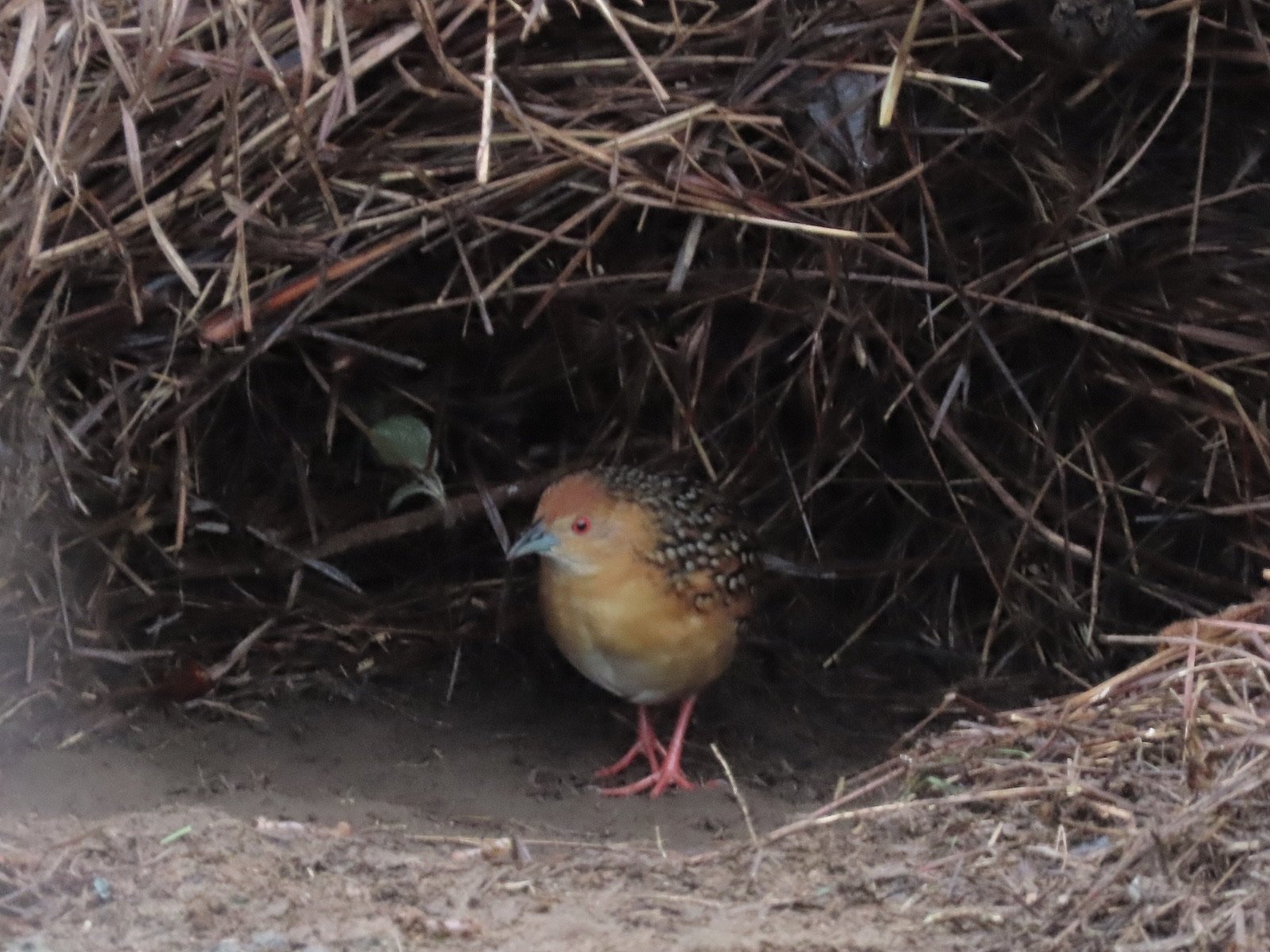
- buffy brown upperparts, thickly spotted with white, in a pattern of white spots edged in black that is unmistakable
- a white throat and whitish belly
- rich buff on the face, sides of the neck and breast
- a red eye, black bill and salmon legs
The Costa Rican birds belong to the nominate subspecies. Compared with the southern subspecies chapmani, they are smaller and darker cinnamon, with bolder black-ringed white spots that cover the rump.
What it sounds like
Recording: Pablo H Capovilla, CC BY 4.0, source, read 4 Nov 2026.
Behaviour and diet
This crake is very secretive. It runs through tall grass and low vegetation and is hard to see at any time of year. In Costa Rica it lives in dense grass, probably using a network of tunnels under the cover, and one birder compared it to a mouse. It is easy to hear but nearly impossible to see.
Rails in general are hard to see because they are small and live in hard-to-reach habitat, so birders identify them by their trills.
Where it lives
The Ocellated Crake lives in dense grassland and savanna. Across its range its natural habitats are dry savanna and seasonally wet or flooded lowland grassland.
In Costa Rica a field guide places it in the relatively dry interior valleys of the south Pacific slope, where several species found nowhere else in the country also live. It prefers dense grassland with scattered shrubs, often in drier areas, and not marshes. The grassy hills above Buenos Aires, in Puntarenas province, are a known spot.
When to see it
Breeding in Costa Rica is suspected to happen in the rainy season, given as May to November.
Similar birds
Its trill is similar to that of the Russet-crowned Crake, its close relative, and sound recordings of the two have been confused. The Ocellated gives a solo trill followed by crying notes, while the Russet-crowned gives a duet trill. The Russet-crowned also has a russet crown, gray face and plain rufous underparts. Among Costa Rica's other small crakes, the Gray-breasted, White-throated and Yellow-breasted, the Ocellated differs in living in dry, dense grassland and savanna, not marshes.
Names and lore in Costa Rica
In Costa Rica the bird is called Polluela Ocelada, a name shared with Colombia and Ecuador. Other Spanish names are used elsewhere: burrito ocelado in Paraguay and Argentina, burrito menor in Bolivia, gallineta de ocelos in Peru, and cotarita de ocelos in Venezuela.
Status and conservation
The AOCR list gives it status R, Avibase lists it as Rare/Accidental in Costa Rica, and elsewhere it is rated Least Concern because its range is huge.
Photography tips
Photography is very hard. Crakes in Costa Rica would not cross even a tiny cleared gap in the grass, but came to the edge of a small clearing and called from one or two meters away, then moved on. Patience at a clearing edge is the best chance.
How we know this 16 sources, each read on the date shown
- Wikipedia read 2026-11-04
https://en.wikipedia.org/wiki/Ocellated_crake - Bird Watching Costa Rica read 2026-11-04
https://www.birdwatchingcostarica.com/ave/ocellated-crake/ - Mindat (Wikipedia text) read 2026-11-04
https://www.mindat.org/taxon-2474399.html - Hotel Rivel blog read 2026-11-04
https://hotelrivel.online/una-joya-moteada-descubriendo-el-polluela-ocelada-en-las-tierras-altas-de-costa-rica/ - Taylor & Francis (Ornithology journal) read 2026-11-04
https://www.tandfonline.com/doi/full/10.1080/23766808.2021.1878983 - ResearchGate (Misiones, Argentina study) read 2026-11-04
https://www.researchgate.net/publication/344570099_Notes_on_a_population_of_Ocellated_Crake_Micropygia_schomburgkii_in_Misiones_province_a_new_rail_for_Argentina - Peru Aves read 2026-11-04
https://www.peruaves.org/rallidae/ocellated-crake-micropygia-schomburgkii/ - Wikipedia (es) read 2026-11-04
https://es.wikipedia.org/wiki/Micropygia_schomburgkii - Cornell Birds of the World read 2026-11-04
https://neotropical.birds.cornell.edu/Species-Account/nb/species/ocecra1/overview - Avibase read 2026-11-04
https://avibase.bsc-eoc.org/checklist.jsp?list=howardmoore®ion=CR - Birdingcraft read 2026-11-04
https://birdingcraft.com/wordpress/2019/04/16/special-birds-in-buenos-aires/ - Manuel Antonio birding (Johan Chaves) read 2026-11-04
https://manuelantoniobirding.wordpress.com/page/12/ - Eagle-Eye Tours trip report read 2026-11-04
https://www.eagle-eye.com/blog/costa-rica-2024-trip-report-feb-28-mar-15-2024/ - Birds of Costa Rica (field guide text) read 2026-11-04
https://dokumen.pub/birds-of-costa-rica-9780691243351.html - Birdingcraft read 2026-11-04
https://birdingcraft.com/wordpress/2013/07/09/birding-costa-rica-around-buenos-aires/ - SINAC / La Gaceta read 2026-11-04
https://www.sinac.go.cr/ES/visasilves/Enlaces%20Inters/05.%20Lista%20especies%20en%20peligro%20de%20extinci%C3%B3n%20y%20poblaciones%20reducidas.pdf