Family Rallidae
Yellow-breasted Crake
Laterallus flaviventer
In Spanish: Polluela Pechiamarilla
- Resident
A tiny marsh crake that steps into view on boat trips in the far north.
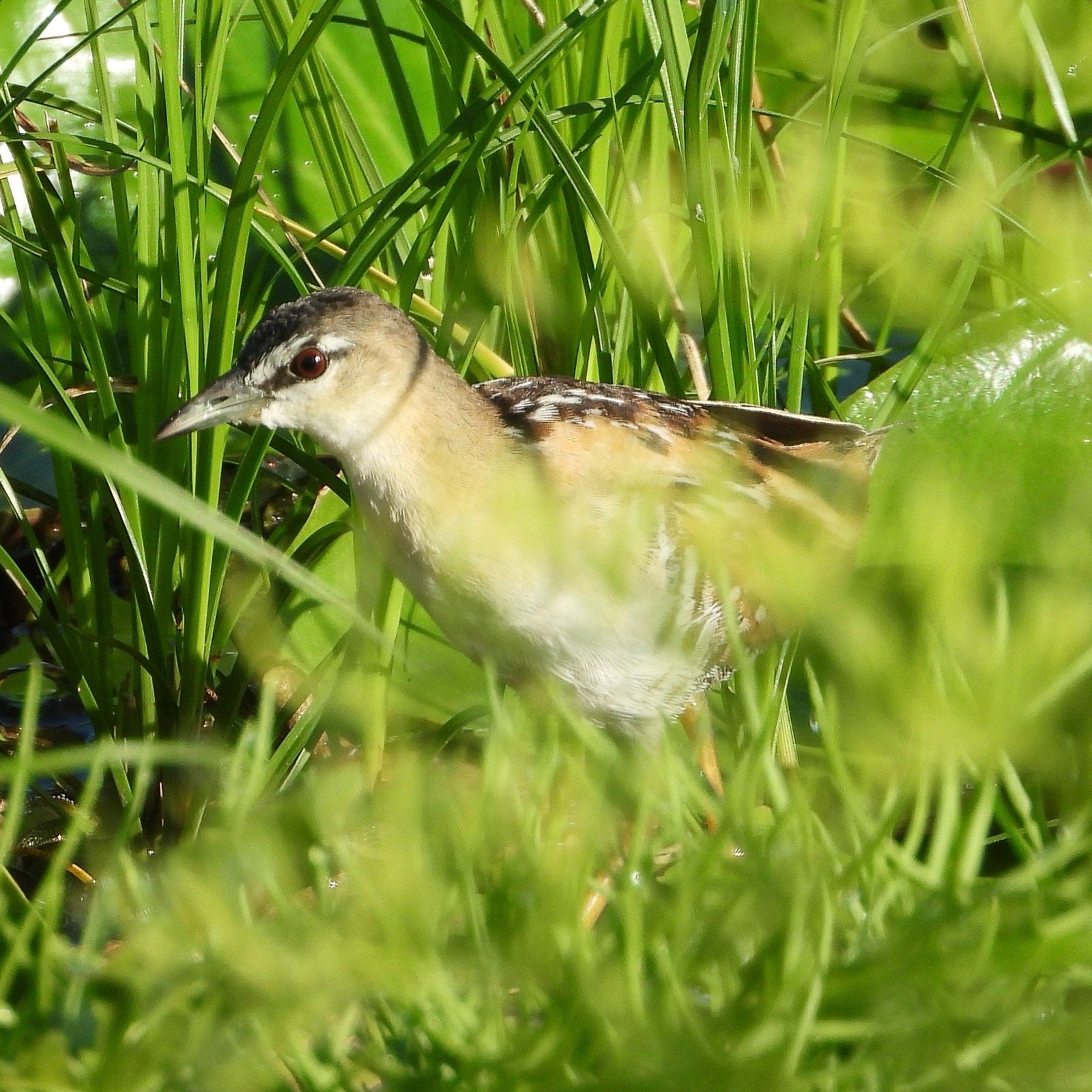
The Yellow-breasted Crake is a very small, yellowish marsh bird with yellow legs. It hides well in every habitat and is seldom seen. In northern Costa Rica, though, it has a name for stepping out.
Visitors usually meet it on boat trips in the northern wetlands. These run on a lagoon and its river channels, and on the Medio Queso wetlands near Los Chiles. A guide there calls it a specialty of Medio Queso.
On a trip we build to the far north, a quiet boat and a patient eye are the whole method. Local boat guides take birders to the right marsh habitat and wait, and one or more crakes often walk into view without any playback.
How to find it
Go by boat, and go with a local guide. Boat guides take birders to the right marsh habitat and wait, and a crake often walks into view without playback. Watch small patches of floating vegetation quietly, because the crake appears after a few moments. Its long toes let it walk lightly over floating leaves, so mats of vegetation are worth scanning. Some visitors spot it while watching a Pinnated Bittern from a boat. A short side trip along the road from Los Chiles to Medio Queso, known for hard-to-see species, is another way to meet it.
How to recognise it
This is a very small crake, about 12.5 to 14 cm long, and the overall impression is yellowish.
Look for these marks:
- a black crown and a black eye stripe that forks at the eye
- a bold, broken white eyebrow between them
- a white throat and a buffy yellow breast
- black and white banded flanks
- a streaked back
- large yellow-orange legs
- a slightly curved, spike-like bill
Males and females look alike, so there is no need to sort the sexes in the field.
What it sounds like
Recording: Pablo H Capovilla, CC BY 4.0, source, read 4 Nov 2026.
Behaviour and diet
The crake feeds among emergent marsh plants, sometimes running across them or climbing in them. It leaves cover at dawn and dusk to feed at the water's edge. When alarmed it runs through weeds or dives rather than flying, and its flight is short and weak, with the legs dangling. At Medio Queso, birders have watched one carry food to hidden young during an afternoon boat trip.
Where it lives
Across its range the species lives in a variety of freshwater marshes. In Costa Rica it belongs to the north of the country, around a wildlife reserve and the Medio Queso wetlands near Los Chiles. Guides there have found it on small patches of floating vegetation in the lagoon. At Medio Queso, boats cruise the waterways beside a big reed bed. In Costa Rica the crake seems to make local movements as water levels change.
When to see it
A Costa Rican guide says the best time for birding in the northern lagoon is the dry season, February to April, when falling water concentrates the birds in fewer places. One lodge runs morning trips to Medio Queso from about February to the end of April, depending on water level.
Similar birds
The face pattern is the best guide: a bold, broken white eyebrow between a blackish crown and a black eye stripe that forks at the eye. Add the yellow-orange legs, the buffy yellow breast and the banded flanks, and it is easy to tell from other small marsh birds.
Names and lore in Costa Rica
Costa Rica's Spanish name is Polluela Pechiamarilla, a name Mexico and Nicaragua share. Other countries use different names, such as polluela de antifaz in Colombia and burrito amarillo in Argentina.
Status and conservation
The AOCR list classes it as a resident in Costa Rica, and the IUCN rates the species Least Concern across its range.
Photography tips
In flight the large yellow-orange legs hang well below the body, and photos from the north show this, along with the blackish cap from above. Scan floating mats of vegetation and be ready, since it runs or dives rather than flying when alarmed.
How we know this 20 sources, each read on the date shown
- Bird Finding read 2026-11-04
https://birdfinding.info/yellow-breasted-crake/ - Caño Negro Experience (TikTok) read 2026-11-04
https://www.tiktok.com/@renatopaniaguacr/video/7608712836830792980 - Wikipedia read 2026-11-04
https://en.wikipedia.org/wiki/Yellow-breasted_crake - Cornell Birds of the World read 2026-11-04
https://birdsoftheworld.org/bow/species/yebcra1/cur/introduction - JungleDragon (from Wikipedia) read 2026-11-04
https://www.jungledragon.com/specie/34025/laterallus_flaviventer.html - Lista Oficial de las Aves de Costa Rica (AOCR) read 2026-11-04
https://listaoficialavesdecostarica.wordpress.com/lista-oficial/lista-oficial-online/ - 10,000 Birds read 2026-11-04
https://www.10000birds.com/quality-birds-at-cano-negro-costa-rica.htm - Eagle-Eye Tours read 2026-11-04
https://www.eagle-eye.com/blog/costa-rica-birding-trip-report-jan-11-27-2026/ - Birding Craft read 2026-11-04
https://birdingcraft.com/wordpress/tag/cano-negro/ - Hotel de Campo Caño Negro read 2026-11-04
https://www.hoteldecampo.com/category/birdwatching-in-costa-rica/ - WhereNext read 2026-11-04
https://www.wherenext.com/blog/the-best-locations-to-film-birds-in-costa-rica - Costa Rica Focus read 2026-11-04
https://www.costaricafocus.com/birding-cano-negro-costa-rica-a-complete-guide/ - Field Guides read 2026-11-04
https://fieldguides.com/triplists/cr220.html - Wikipedia (es) read 2026-11-04
https://es.wikipedia.org/wiki/Porzana_flaviventer - Ingrid Knudsen Natural read 2026-11-04
https://ingridknudsennatural.com/giras/cano-negro-y-medio-queso - Visit Costa Rica mini-guide read 2026-11-04
https://fr-ca.visitcostarica.com/sites/default/files/2024-10/MINIGUIA%20CANO%20NEGRO.pdf - El Norte Hoy read 2026-11-04
https://elnortehoycr.com/2021/08/18/404-especies-de-aves-registra-el-inventario-nacional-humedales-en-cano-negro/ - El Norte Hoy read 2026-11-04
https://elnortehoycr.com/2019/11/19/en-cano-negro-se-han-contado-243-especies-de-aves/ - El Universal read 2026-11-04
https://archivo.eluniversal.com.mx/internacional/82016.html - Ecoregistros read 2026-11-04
https://www.ecoregistros.org/sheet/Laterallus-flaviventer&idusuario=4008