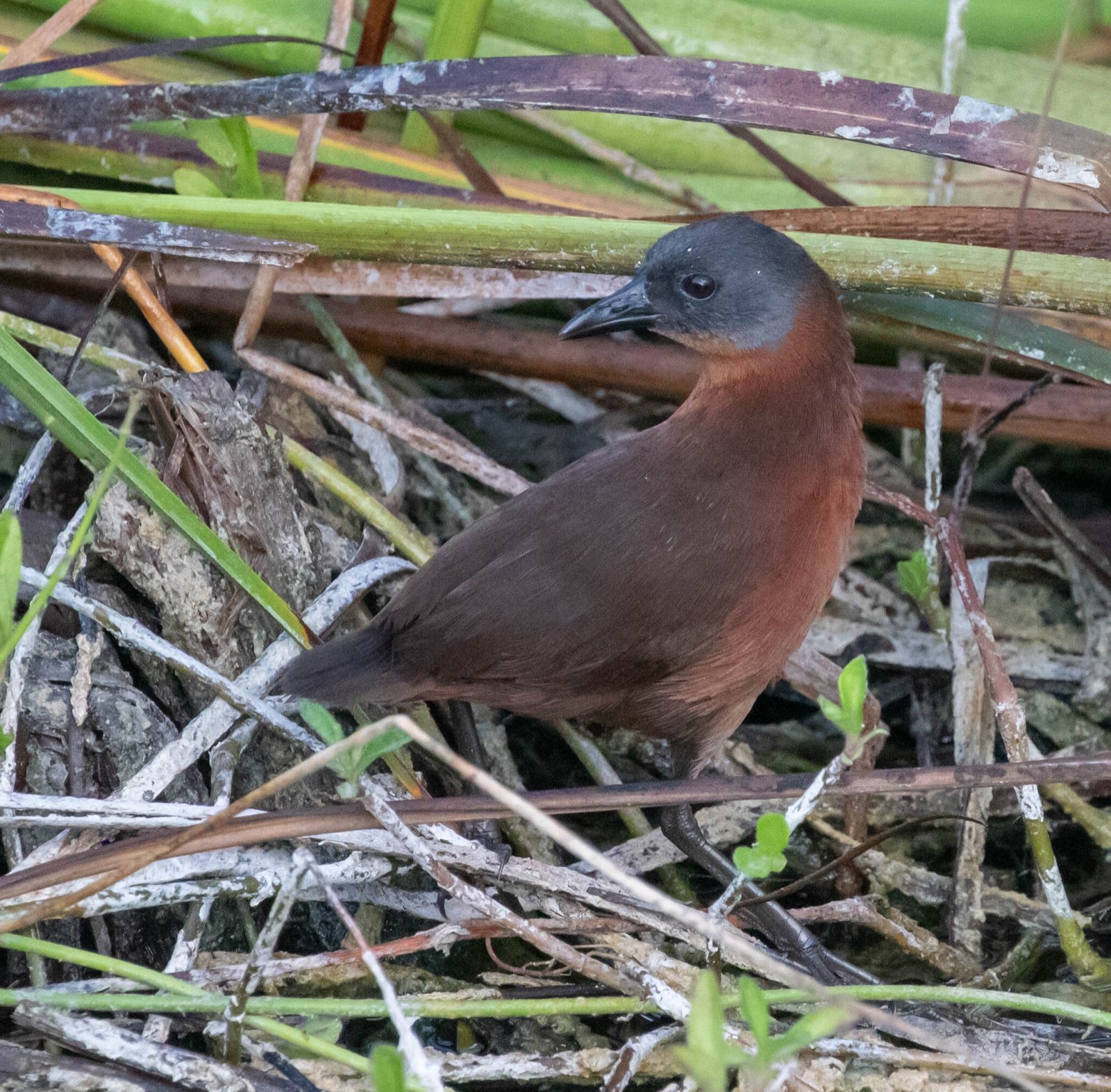
Family Rallidae
Ruddy Crake
Laterallus ruber
In Spanish: Polluela Colorada
- Resident
A rare chestnut marsh crake, easier to hear than to see.
The Ruddy Crake (Polluela Colorada, Laterallus ruber) is one of the most puzzling birds on the Costa Rican list. It is a small, nearly all chestnut crake of marshes and wet grass, and it walks quietly and runs fast, so most of what people know of it comes from sound.
In Costa Rica it is rare. The national bird association once listed it as possibly extinct after about twenty years without a sighting, and the official list, updated June 2026, still puts a question mark after its resident status.
That makes it a bird for patient, curious birders rather than a sure thing. A May 2007 sighting at La Selva Biological Station came after that listing, and it is the one modern Costa Rican place named for it.
How to find it
Listen first, because the descending trill is far easier to catch than the bird is to spot. Focus on flooded areas of tall grass and cane, and on wet meadows, roadside ditches and tall-grass pastures. The Caribbean side is the likelier bet than the Pacific. Expect it to run fast and stay hidden even when it calls, and treat any view as a bonus.
How to recognise it
The Ruddy Crake is about the size of a sparrow, 14 to 16.5 cm long. Look for these marks:
Bright chestnut plumage overall, with a paler chin and belly.
A gray head that contrasts with the rufous body, with a blackish crown and dark grey ear patches.
Dark brown wings and tail.
A black bill and greenish legs.
A buffy throat and no bars on the flanks.
Within its range it is the only small rail that is almost entirely chestnut, which is the quickest way to separate it from other crakes. That matters when a marsh crake gives only a short view.
What it sounds like
Behaviour and diet
This is a secretive bird that is easier to hear than to see. It walks quietly and runs fast, and it favours flooded areas of tall grass and cane, which makes it hard to observe.
It feeds on the ground, probably on invertebrates, and another account says it eats insects.
Where it lives
Across its range the Ruddy Crake lives in wetlands such as marshes, flooded fields, wet meadows, roadside ditches and tall-grass pastures. It is found from the lowlands up to 1500 m.
In Costa Rica the range is given as lowlands reaching northwestern Costa Rica, specifically northern Guanacaste. A summary of a Costa Rican field guide says it is more likely to turn up on the Caribbean side than the Pacific side, where records are few.
Similar birds
The White-throated Crake, a commoner Costa Rican marsh crake, has a clear white throat and flanks barred in black and white. The Ruddy Crake instead has a buffy throat, a gray head and no flank bars. Gray-breasted and Yellow-breasted Crakes share the Costa Rican list, but only the Ruddy is nearly all chestnut.
Names and lore in Costa Rica
Costa Rican names include Polluela Colorada and Polluela Rojiza. Other Spanish names include Polluela Canela, Burrito Colorado and Gallineta Colorada.
Status and conservation
The Costa Rican bird list marks it R?-SC, meaning its status is uncertain and it is not a firmly established resident, while its global status is Least Concern.
How we know this 17 sources, each read on the date shown
- Lista Oficial de las Aves de Costa Rica (AOCR) read 2026-11-04
https://listaoficialavesdecostarica.wordpress.com/lista-oficial/lista-oficial-online/ - Animalia (citing Wikipedia) read 2026-11-04
https://animalia.bio/ruddy-crake - Wikipedia (Spanish) read 2026-11-04
https://es.wikipedia.org/wiki/Laterallus_ruber - Avibase (Clements checklist) read 2026-11-04
https://avibase.bsc-eoc.org/species.jsp?avibaseid=E75C88E28F590DCA - Birda read 2026-11-04
https://app.birda.org/species-guide/5985/Ruddy_Crake - Birds of the World (Cornell) read 2026-11-04
https://birdsoftheworld.org/bow/species/rudcra1/cur/introduction - Birds of the World (Cornell, Spanish) read 2026-11-04
https://birdsoftheworld.org/bow/species/rudcra1/cur/introduction?lang=es&printable= - Aves de Costa Rica read 2026-11-04
https://avesdecostarica.com/Laterallus-albigularis.html - Bird Watching Costa Rica read 2026-11-04
https://www.birdwatchingcostarica.com/ave/ruddy-crake/ - birdlist.org read 2026-11-04
https://www.birdlist.org/aves/aves_de_costa_rica.htm - NaturaLista Mexico (from Wikipedia) read 2026-11-04
https://www.naturalista.mx/guide_taxa/288439 - Animalia read 2026-11-04
https://animalia.bio/ruddy-crake?taxonomy=1796 - Wikipedia read 2026-11-04
https://en.wikipedia.org/wiki/Laterallus_ruber - Avibase (Guanacaste checklist) read 2026-11-05
https://avibase.bsc-eoc.org/checklist.jsp?region=CRgu - Avibase (Guanacaste National Park checklist) read 2026-11-05
https://avibase.bsc-eoc.org/checklist.jsp?region=BZcy03 - Trust for Avian Systematics, H&M4 Checklist read 2026-11-05
https://www.aviansystematics.org/4th-edition-checklist?viewfamilies=42 - Focus On Nature Tours bird list read 2026-11-05
http://focusonnature.com/BirdListCostaRica.htm