Family Hirundinidae
Barn Swallow
Hirundo rustica
In Spanish: Golondrina Tijereta
- Migrant
A glossy blue, scissor-tailed migrant that streams along both coasts.
The Barn Swallow, Golondrina Tijereta in Spanish, is a migrant in Costa Rica, and when it comes it comes in numbers. Autumn passage runs from early or mid August to October, and spring passage from early March to late May.
On a trip we build around migration, the southeast near the Caribbean coast can be a rewarding place to meet them. In October swallows move through almost constantly there, mostly Barn, Cliff and Bank, and one observer estimated about 6,000 Barns passing in two hours.
For a beginning birder it is a friendly first swallow: it flies in the open and the deeply forked tail is easy to spot. Many Barn Swallows also stay for the winter in open lowland country.
How to find it
During migration on both coasts, look for them flying low over the ground or water early in the morning, at dusk or in bad weather. On sunny days they usually climb higher around midday, so the hour and the light matter. Groups can pass nonstop along coastlines for days or weeks, moving parallel to the shore, so a coastal viewpoint is a good place to watch. For wintering birds, scan open lowland country such as pastures, rice fields, marshes and gardens. Check birds perched on wires too, because a rarer swallow can hide among them.
How to recognise it
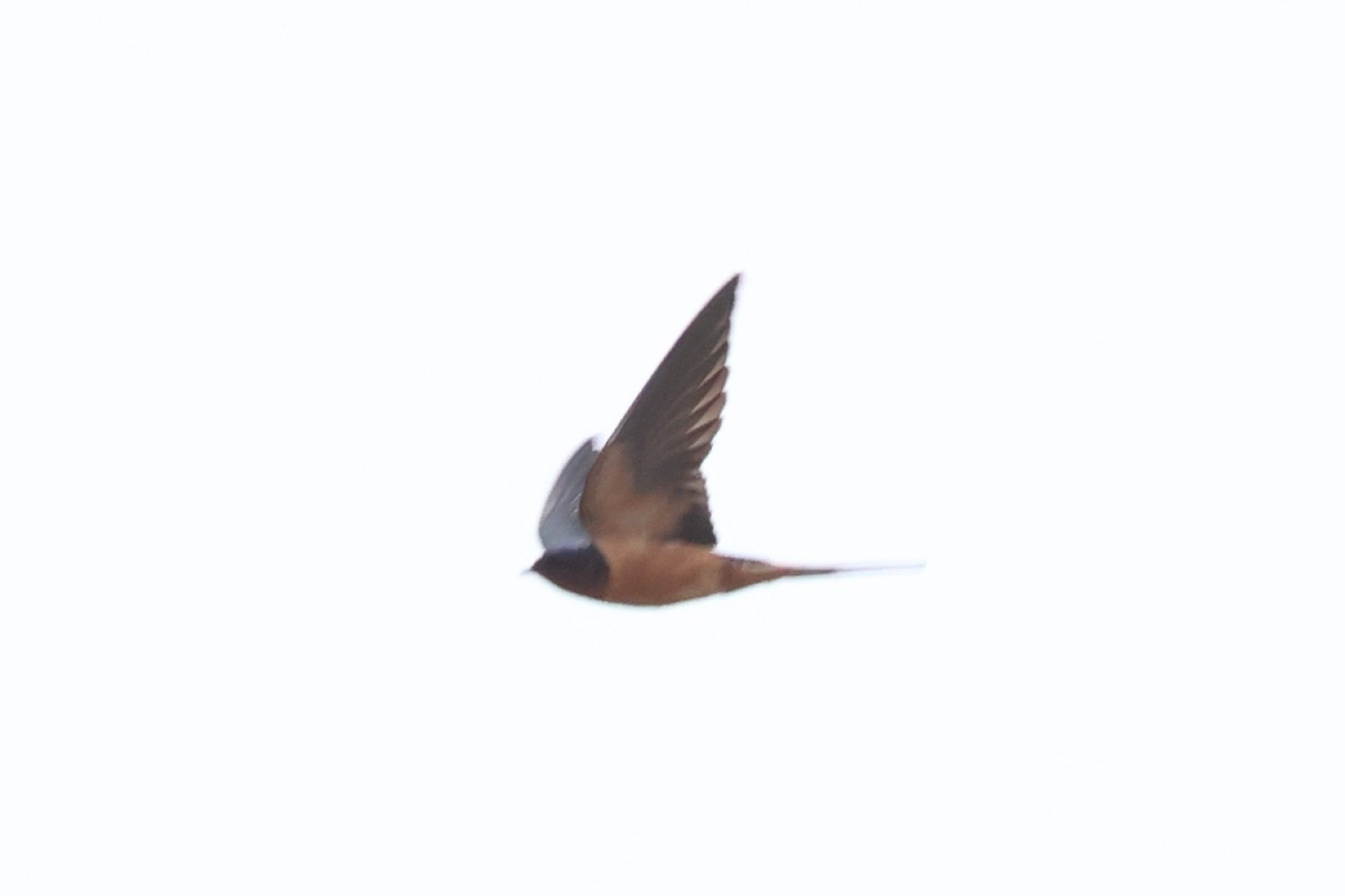
The adult has a glossy dark blue back and a deeply forked tail. The forehead, throat and chest are dark rufous, with an incomplete dark band across the chest. The bill and legs are black.
Tail streamers are longer in males and adults, so the sharpest forks usually belong to older birds. Females are on average paler below than males.
All tail feathers except the central pair carry white spots on the inner web. Seen from below with the tail spread, this white band of spots is a helpful mark for confirming the species.
Young birds look duller, with a brownish back mixed in. Their head is mostly dusky, and the forehead shows pale buff spots.
What it sounds like
Recording: Kieran Roy Powell, CC BY 4.0, source, read 4 Nov 2026.
Behaviour and diet
The Barn Swallow catches insects in flight. It is sociable and gathers in big communal roosts, and smaller groups leave the roost each day to feed.
Migrants pass in spaced-out groups, flying low over ridges and higher over valleys. In Costa Rica they forage low over fields and join other swallows over houses, and they need no barns here. Migrants gather over water when bad weather cuts insect numbers.
Where it lives
In winter the species prefers open areas in Costa Rica, such as gardens, pastures, rice fields and marshes. Expect plenty in open lowland habitats, where many stay for the winter.
Passage birds are most numerous along both coasts. Smaller numbers turn up now and then through the lowlands of both slopes and up into the Central Valley. At higher elevations it is uncommon to rare, though it sometimes climbs as high as 3000 m, and it can be seen soaring through mountain valleys during migration.
When to see it
Barn Swallows pass through in autumn, from early or mid August to October, and again in spring, from early March to late May. Migrants arrive in bulk by early October, though the first Barn and Cliff Swallows show up earlier, around the start of September in one resident's notes.
Similar birds
The Blue-and-white Swallow often forages with Barn Swallows over houses. It is smaller and darker below, with a dark vent and flanks and a shorter forked tail. Bank Swallow is pale below with a thin breast band, and Cliff Swallow shows a dark throat; both pass through with Barns. Eastern Kingbirds fly in flocks and look a bit like swallows, mixing with the migrating streams in the southeast. A rare Cave Swallow can blend in with Barns perched on wires; one was seen near Chomes on the Gulf of Nicoya in November.
Names and lore in Costa Rica
Costa Rican sources list the Spanish names Golondrina Tijereta and plain Golondrina. Tijereta means scissor-tail, a nod to the deeply forked tail.
Status and conservation
The AOCR lists the Barn Swallow as a migrant (M), and with a huge range and population it is not threatened with extinction.
Photography tips
Early morning, dusk and bad weather keep migrants low over ground or water, which makes them easier to photograph. Open the tail shot if you can: the white band of spots on the spread tail confirms the species.
How we know this 17 sources, each read on the date shown
- Aves de Costa Rica read 2026-11-04
https://avesdecostarica.com/Hirundo-rustica.html - Flickr (Costa Rican natural history notes) read 2026-11-04
https://www.flickr.com/photos/jobando/29802320595/ - Birding Craft read 2026-11-04
https://birdingcraft.com/wordpress/2021/11/09/which-migrant-species-are-encountered-most-often-while-birding-in-costa-rica/ - Birding Craft read 2026-11-04
https://birdingcraft.com/wordpress/2024/10/08/birding-in-southeastern-costa-rica-highlights-observations-and-recommendations/ - Birding Craft read 2026-11-04
https://birdingcraft.com/wordpress/2017/11/15/highlights-from-birding-in-costa-rica-at-chomes-and-ensenada/ - Wikipedia (Spanish) read 2026-11-04
https://es.wikipedia.org/wiki/Hirundo_rustica - Birding Craft read 2026-11-04
http://birdingcraft.com/wordpress/2025/09/01/reminders-of-bird-migration-in-costa-rica/ - Wikipedia read 2026-11-04
https://en.wikipedia.org/wiki/Barn_swallow - Hotel Rivel blog read 2026-11-04
https://hotelrivel.online/a-flash-of-blue-in-the-mountains-the-barn-swallow/ - Birding Craft read 2026-11-04
https://birdingcraft.com/wordpress/2020/04/20/pondering-swifts-and-swallows-during-quarantine-birding-in-costa-rica/ - Ecoregistros read 2026-11-04
https://www.ecoregistros.org/ficha/Hirundo-rustica?idprovincia=61 - iNaturalist Mexico (CONABIO text) read 2026-11-05
https://mexico.inaturalist.org/taxa/11901 - BC Conservation Data Centre (citing Stiles and Skutch 1989) read 2026-11-05
https://a100.gov.bc.ca/pub/eswp/speciesSummary.do?id=17978 - Birds of the World (Cornell) read 2026-11-05
https://birdsoftheworld.org/bow/species/barswa/cur/movement - Birds of the World (Cornell) read 2026-11-05
https://birdsoftheworld.org/bow/species/barswa/cur/habitat - iNaturalist guide (Wikipedia text) read 2026-11-05
https://www.inaturalist.org/guide_taxa/840673 - COSEWIC status report 2021 read 2026-11-05
https://www.canada.ca/en/environment-climate-change/services/species-risk-public-registry/cosewic-assessments-status-reports/barn-swallow-2021.html