Family Hirundinidae
Cliff Swallow
Petrochelidon pyrrhonota
In Spanish: Golondrina Risquera
- Migrant
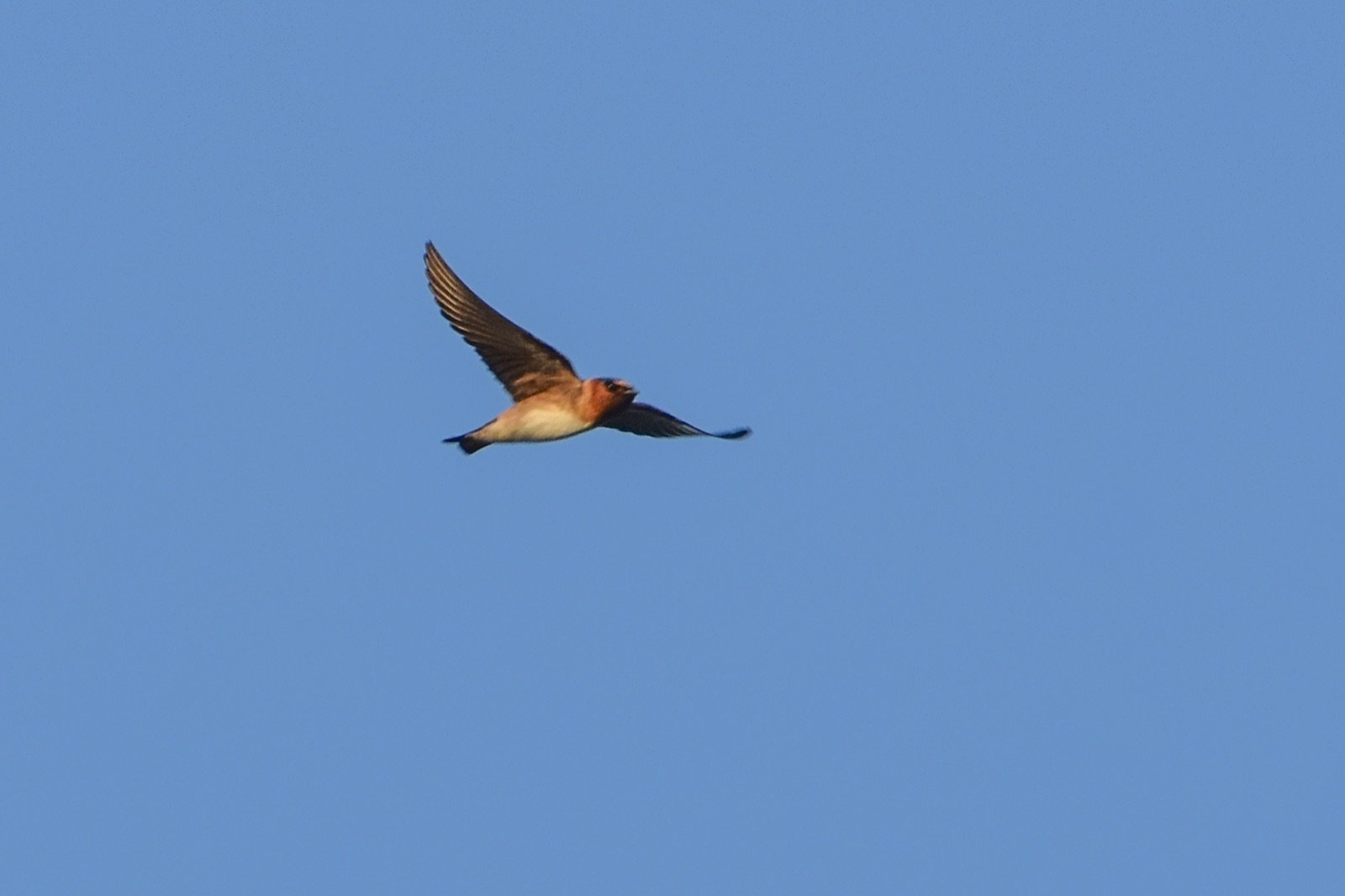
A square-tailed, chestnut-throated swallow streaming through on migration.
The Cliff Swallow is a bird of passage here. It breeds from Alaska and northern Canada south to Mexico and winters mainly in southern South America, so Costa Rica sees it mostly as it travels between the two.
It crosses the country in small numbers, moving along both coasts. A few birds spend the northern winter here, very few but regularly, mostly in Guanacaste.
For a beginning birder it is a good lesson in swallow identification. It often flies among Barn Swallows, and it rewards a careful look at the throat and the tail.
How to find it
Look where insects are plentiful, since migrants may stay a few minutes or several days where feeding is good. Watch swallows feeding over an open backyard or field from a fixed spot, because migrating Cliff Swallows often fly high overhead and are easily missed. Scan perched groups on power lines and barbed wire for the chestnut throat. Among flying Barn Swallows, check for the dark throat and square tail. Even in a good spot, flocks may fly too high for a sure identification, so patience helps. On the Turrialba Volcano slopes, a birder saw more than 500 swallows pass overhead in late April, probably Cliff Swallows heading toward the Caribbean coast.
How to recognise it
The Cliff Swallow is a compact swallow with a squared tail and a dark blue back. Look for these marks:
Rump: pale or buffy.
Underparts: pale.
Throat: chestnut.
Forehead: pale to whitish.
Wings: long and pointed.
Overall it looks blockier than similar swallows. Young birds can look different. The whole head is usually dark brownish black, with at most a small pale forehead patch, and the throat pattern varies a lot from bird to bird.
What it sounds like
Behaviour and diet
In winter the Cliff Swallow mostly eats small insects taken close to the ground or water. Birds perch in groups on power lines or barbed wire, each keeping some space from its neighbours.
Migrating birds may stay anywhere from a few minutes to several days in areas with good feeding.
Across its range it nests in colonies and builds gourd-shaped mud nests under eaves, on cliffs, and under bridges or dams.
Where it lives
In Costa Rica it is a passage migrant, normally seen only while migrating. Birds move along both coasts, and inland it is less common than on the coasts.
In autumn fairly large numbers still cross the Central Valley, passing the continental divide at Ochomogo from west to east. In spring fewer cross, moving east to west.
The few birds that winter here are mostly in Guanacaste.
When to see it
The autumn passage runs from late August or early September to late October, and the spring passage from early March to late May. One source gives a wider window for records of migrants, from late July to the end of November.
Similar birds
Barn Swallow is the bird most often mixed up with it. Both are colourful, but the Cliff Swallow has a square tail and a rusty rump, while the Barn Swallow has a deeply forked tail. Cave Swallow also has a buffy rump and square tail, but its throat is buffy orange rather than dark chestnut. Bank Swallows pass with Cliffs too, pale below with a thin breast band and a slighter build. A different-looking migrant over the house may even be a rare Tree or Violet-green Swallow.
Names and lore in Costa Rica
The Spanish name on the Costa Rican bird list is Golondrina Risquera. Risquera refers to cliffs.
Status and conservation
The AOCR lists it as M, a migrant, and in Costa Rica it is a passage migrant seen in small numbers, while it winters mainly in southern South America.
Photography tips
Migrating birds may stay from a few minutes to several days in areas with good feeding, so look for them where insects are plentiful. Watching swallows feed over an open backyard or field from a fixed spot gives the best chance of picking them out, since many fly high and are easily missed.
How we know this 21 sources, each read on the date shown
- Flickr photo caption with Costa Rican natural history text (Spanish) read 2026-11-04
https://www.flickr.com/photos/jobando/44084680365 - Featherscan (summarising Wikipedia) read 2026-11-04
https://www.featherscan.com/birds/cliff-swallow - Minnesota Seasons read 2026-11-04
https://www.minnesotaseasons.com/Birds/Cliff_Swallow.html - W.K. Kellogg Bird Sanctuary read 2026-11-04
https://birdsanctuary.kbs.msu.edu/2022/06/28/golondrinas-por-todas-partes/ - National Wildlife Foundation species page read 2026-11-04
https://nwlfd.org/species/cliff-swallow - Cornell Birds of the World (Cave Swallow) read 2026-11-04
https://birdsoftheworld.org/bow/species/cavswa/cur/appearance - National Geographic read 2026-11-04
https://www.nationalgeographic.com/animals/birds/facts/cliff-swallow - Bird Watching Costa Rica read 2026-11-04
https://www.birdwatchingcostarica.com/familia/hirundinidae/ - Cliff Swallow Project natural history page read 2026-11-04
https://www.cliffswallow.org/natural-history - Birds for Beer read 2026-11-04
https://birdsforbeer.com/2015/04/25/migrating-cliff-swallows-and-a-woodcreeper-nest/ - Birding Craft read 2026-11-04
https://birdingcraft.com/wordpress/2021/11/09/which-migrant-species-are-encountered-most-often-while-birding-in-costa-rica/ - Field Guides Costa Rica 2018 trip list read 2026-11-04
https://fieldguides.com/triplists/cos18.html - Flickr natural history entry (Ceiba, Orotina) read 2026-11-04
https://www.flickr.com/photos/jobando/44084682295 - Birding Craft read 2026-11-04
https://birdingcraft.com/wordpress/2020/04/20/pondering-swifts-and-swallows-during-quarantine-birding-in-costa-rica/ - Costa Rica Living and Birding (birdingcraft) read 2026-11-05
https://birdingcraft.com/wordpress/page/8/ - Costa Rica Living and Birding (birdingcraft) read 2026-11-05
https://birdingcraft.com/wordpress/2024/03/03/early-spring-migrants-on-the-move-in-costa-rica/ - Costa Rica Living and Birding (birdingcraft) read 2026-11-05
http://birdingcraft.com/wordpress/2025/09/01/reminders-of-bird-migration-in-costa-rica/ - Birdfinders trip report, Costa Rica 2011 read 2026-11-05
https://birdfinders.co.uk/pdf/costa-rica-2011.pdf - Field Guides Costa Rica 2017 trip list read 2026-11-05
https://fieldguides.com/triplists/cos17.html - Costa Rica Living and Birding (birdingcraft) read 2026-11-05
http://birdingcraft.com/wordpress/ - Costa Rica Living and Birding (birdingcraft) read 2026-11-05
https://birdingcraft.com/wordpress/category/birds-to-watch-for-in-costa-rica/