Family Caprimulgidae
Common Nighthawk
Chordeiles minor
In Spanish: Añapero Zumbón
- Resident
Bat-like dusk flier, best seen on autumn and spring migration
The Common Nighthawk is a bird you look up for. In Costa Rica it is mainly a migrant: large numbers pass through in autumn, from September to early November, and it is sporadically common again in March and April.
Most autumn birds follow the Caribbean coast and adjacent lowlands, though some cross the Central Valley and Pacific lowlands. A few also breed on windswept savannas in the northwest and in the Térraba area, so the official list calls it a rare resident plus a migrant.
They pass in huge numbers yet are easy to miss, because people rarely look up at the right time. Around dawn and dusk, that changes.
How to find it
Look for them in flight at dawn and dusk while they hunt flying insects. If you see none, listen for low buzzy 'peent' calls overhead. A Costa Rica resident birder says that to see nighthawks on migration he usually has to go to the Caribbean lowlands or coast. Small numbers do pass through the Central Valley, and one birder had a nighthawk swoop past at eye level there. The most reliable time is during migration, so plan around the autumn and spring passage.
How to recognise it
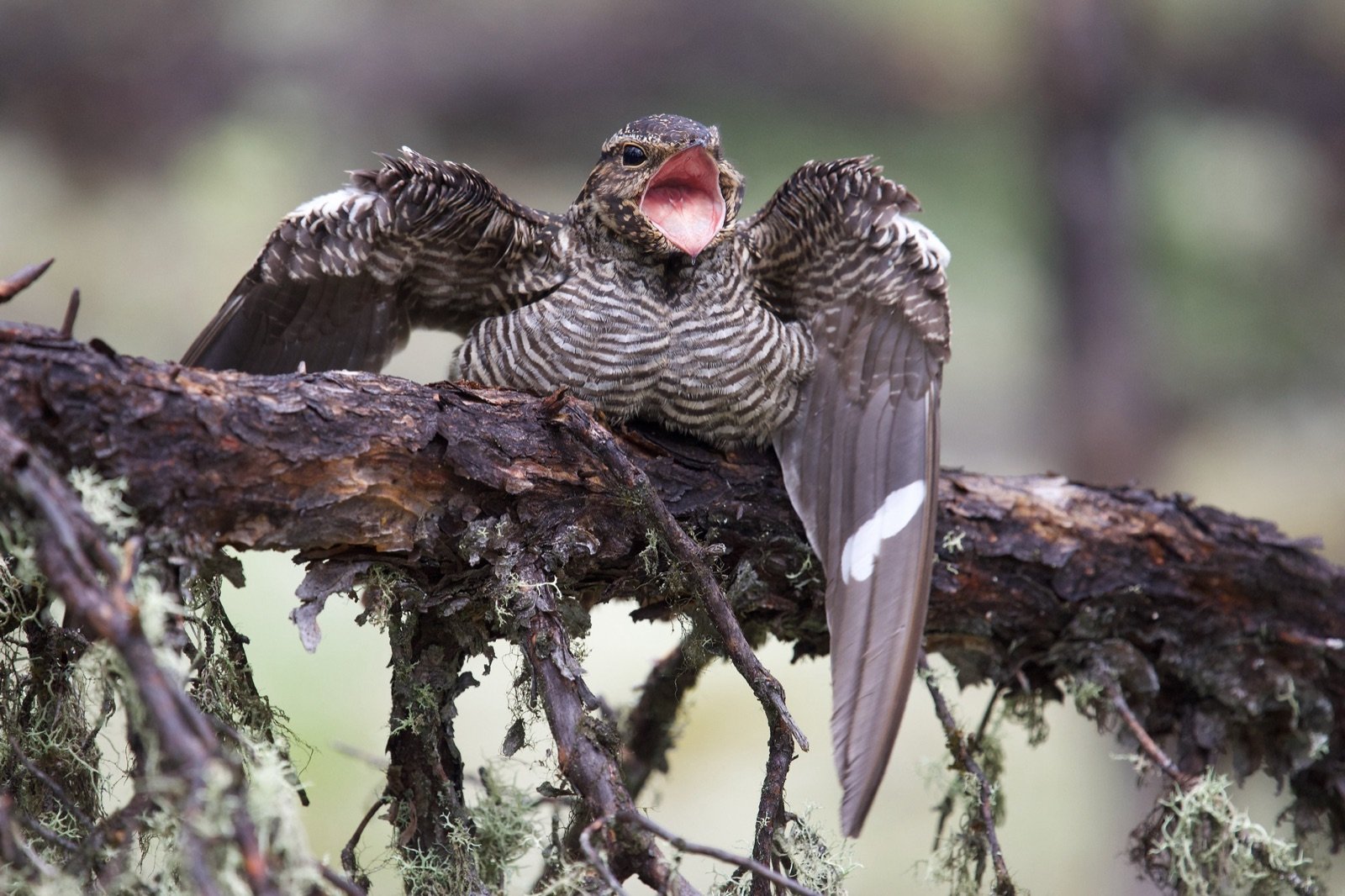
Look for long, pointed wings and a notched tail.
A white band crosses the wing feathers midway between the wrist bend and the wingtip. It is the mark that catches the eye in flight.
The throat patch is white in males and buffy in females.
On male Commons the white wing spot looks staggered on the closed wing.
With the wings folded, they reach about as far back as the tail tip.
It is slightly larger than the Lesser Nighthawk, which is the look-alike in Costa Rica.
What it sounds like
Recording: Clifton Ladd, C.W.B., CC BY 4.0, source, read 4 Nov 2026.
Behaviour and diet
Nighthawks are more daytime and aerial than other nightjars, and they often start flying before dusk. They catch flying insects in the air and feed mostly near dawn and dusk. Sometimes they feed at night under a full moon or near street lights.
During courtship the male makes a booming sound in display flight. Nighthawks migrating over Costa Rica can be seen in daylight, especially on the Caribbean coast, and many more probably drift overhead silently at night.
Where it lives
Spring migrants occur over much of Costa Rica below about 1300 m. In autumn the main flow runs along the Caribbean coast and adjacent lowlands, with smaller numbers through the Central Valley and Pacific lowlands.
The few breeders use windswept, rolling savannas on the lower Pacific slopes of the Guanacaste mountains and in the Térraba area. Other Guanacaste sites are possible. These breeders seem to move south after nesting.
When to see it
Large numbers pass through in autumn, from September to early November. It is sporadically common in spring migration, in March and April, and absent from mid-November to late March.
Similar birds
The Lesser Nighthawk is smaller, lighter and paler than the Common. Its pale wing bar sits nearer the wingtip than the shoulder. On Lessers the white spot looks more like a patch, and they have buff marks on the primaries.
Names and lore in Costa Rica
Besides the official Añapero Zumbón, Costa Rica's biodiversity atlas lists Añapero. Other Spanish names include añapero yanqui, añapero boreal, añapero migratorio, aguaitacamino común and chotacabras zumbón. The Lesser Nighthawk's local Costa Rican name is given as Gavilán.
Status and conservation
The official Costa Rican list rates it RR,M, a rare resident plus a migrant, while the IUCN Red List rates it Least Concern worldwide, though numbers are falling across its range.
Photography tips
Many nighthawks pass in huge numbers but are easy to miss, because people rarely look up at the right time. Watch the sky at dawn and dusk during migration, and on the Caribbean coast scan in daylight too.
How we know this 18 sources, each read on the date shown
- Aves de Costa Rica read 2026-11-04
https://www.avesdecostarica.org/caprimulgidae.html - Bird Watching Costa Rica read 2026-11-04
https://www.birdwatchingcostarica.com/ave/common-nighthawk/ - Birds of Costa Rica (Tom Friedel) read 2026-11-04
https://www.birdsofcolombia.org/costarica/Chordeiles.html - Lista Oficial de las Aves de Costa Rica (AOCR) read 2026-11-04
https://listaoficialavesdecostarica.wordpress.com/lista-oficial/lista-oficial-online/ - ArgentiNat (IUCN listing) read 2026-11-04
https://www.argentinat.org/taxa/19577-Chordeiles-minor - Wikipedia read 2026-11-04
https://en.wikipedia.org/wiki/Common_nighthawk - Audubon Field Guide read 2026-11-04
https://www.audubon.org/field-guide/bird/common-nighthawk - Columbus Audubon read 2026-11-04
https://columbusaudubon.org/common-nighthawks-acrobats-of-the-bird-world/ - Cornell Lab, All About Birds read 2026-11-04
https://www.allaboutbirds.org/guide/Common_Nighthawk/overview - Spanish Wikipedia read 2026-11-04
https://es.wikipedia.org/wiki/Chordeiles_minor - GBIF / Atlas de la Biodiversidad de Costa Rica read 2026-11-04
https://www.gbif.org/taxon/5YB2W - Vermont Center for Ecostudies read 2026-11-04
https://vtecostudies.org/blog/nighthawks-light-up-late-summer-evening-skies-an-october-reminiscence - Birdingcraft read 2026-11-04
http://birdingcraft.com/wordpress/ - Birdingcraft read 2026-11-04
https://birdingcraft.com/wordpress/2010/08/30/migrants-are-on-their-way-back-to-costa-rica/ - 10,000 Birds read 2026-11-04
https://www.10000birds.com/what-flies-over-costa-rica-in-the-night.htm - BirdForum read 2026-11-04
https://www.birdforum.net/threads/costa-rica-lesser-or-common-nighthawk.192374/ - Flickr (Costa Rican biodiversity atlas text) read 2026-11-04
https://www.flickr.com/photos/jobando/26529133411 - Journal of Field Ornithology read 2026-11-04
https://journal.afonet.org/vol94/iss3/art8/