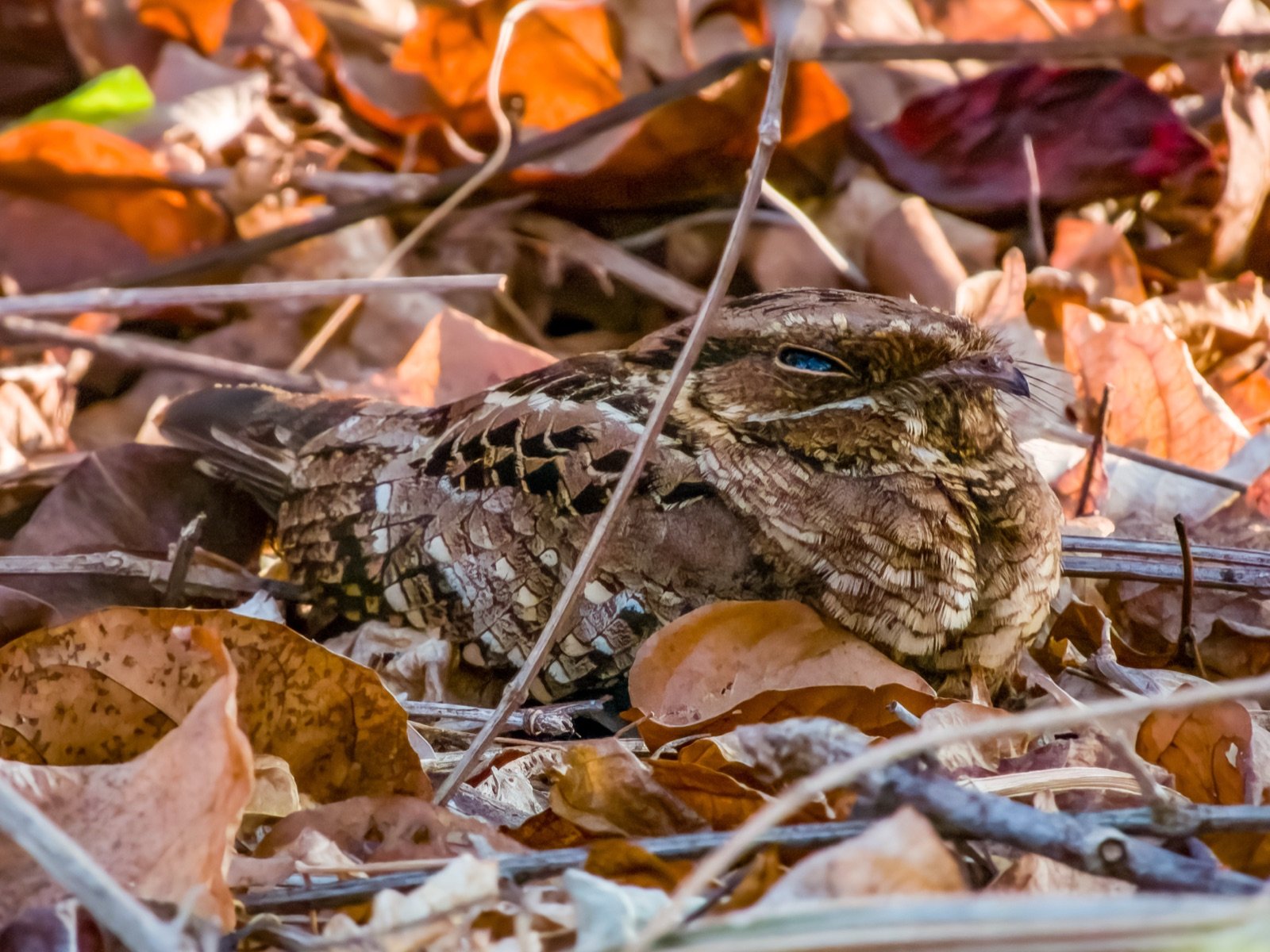
 Common Pauraque
Family Caprimulgidae
Common Pauraque
Nyctidromus albicollis
In Spanish: Tapacaminos Común (Cuyeo, Pucuyo)
- Resident
The nightjar whose ruby eyes glow on rural roads after dark.
The Common Pauraque is the most common nightjar on Costa Rica's rural roads, and after dark its eyes glow ruby red in vehicle headlights. By day it is very hard to find, because it lies camouflaged on the forest floor and often flies off before anyone notices it.
Costa Ricans know it as the cuyeo, a name that imitates its drawn-out 'cuyeooo' call. Rural lore calls it the bird that loses people, because it hops up from the ground and lands again a few meters ahead of walkers.
It is found across the whole country, from sea level up to about 1,700 meters. On a trip we build, a night walk after dinner or a slow evening drive on a quiet rural road is the natural way to meet it.
How to find it
Go out at the start of the night or at dawn, when the cuyeo is usually seen. Rural roads are the best bet: scan ahead with a light and look for eyeshine, which glows ruby red and shows from a distance. Birds also perch on dirt roads, so drive or walk slowly. Do not count on finding one by day, as it is camouflaged and often flies before you notice it. A night walk after dinner can work too, as a tour group found one in the Lagunillas dry forest area of Carara National Park. Listen at dusk for the call, which is often the first sign.
How to recognise it
The Common Pauraque is a medium-sized nightjar about 28 cm long, with a very long tail and long, rounded wings.
Plumage: gray-brown to tawny, with black streaks and a white throat band.
A roosting bird: buff spots on the wing coverts, chestnut cheeks, no collar on the nape, and a long rounded tail.
In flight, across the species' range: males show a white band across the primaries and white outer tail feathers. Females show less white, and the wing band is narrower and often buffy.
By day the camouflage on the ground is so good that eyeshine at night is usually the easier clue.
What it sounds like
Behaviour and diet
After dark the pauraque catches insects by flying up from the ground in openings, forest gaps and near lights. It hunts by waiting on a perch or the ground, then launching at an insect, and it sometimes works around street lamps where insects gather in the evening.
The female usually lays two eggs on the ground with no real nest and sits on them by day. If a predator comes near, she may act injured to draw it away.
On a road, a cuyeo often flies up just ahead, flaps and drops down further on. It may lead walkers on, which draws them away from its eggs or chicks.
Where it lives
The pauraque lives across the whole of Costa Rica, from sea level up to about 1,700 meters, and is a resident. Visitors can meet it on rural roads, in coffee plantations, in scrub and in secondary growth.
It hunts over roads, pastures, young forest plantations, burned areas and forest edges. Across its range, roosting birds sit on the ground in shaded spots in scrub, light woods, hedgerows and coffee farms, and they avoid dense forest. A Costa Rican article calls it typical of the northern lowlands, the Huetar Norte region, as well as other parts of the country.
When to see it
A Costa Rican article says the cuyeo's song is heard on moonlit nights in the dry season. It is usually seen at the start of the night or at dawn. Folklore says its call in April and May brings the rains.
Similar birds
Other nightjars can look alike, so check a roosting bird closely. The pauraque shows buff spots on the wing coverts, chestnut cheeks, no collar on the nape and a long rounded tail. The white throat band adds to the picture.
Names and lore in Costa Rica
The AOCR lists it as Tapacaminos Común, with Cuyeo and Pucuyo as local names. Cuyeo imitates its call. Tapacaminos means roughly 'road blocker', and elsewhere in South America it is called aguaitacamino, a name linked to its habit of sitting on roads like a guardian.
An old belief, also told in Costa Rica, says the bird sucks milk from cows or goats, hence the name chotacabras. The museum explains that insects gather around nursing calves, and the bird simply hunts them there.
Rural lore holds that the cuyeo 'loses' people, from the way it hops up from the ground and lands again a few meters ahead of walkers.
Status and conservation
A resident (R on the AOCR list), fairly common to abundant throughout Costa Rica, from the lowlands and locally up to 1,700 m.
Photography tips
Eyeshine is the key: the eyes reflect lamplight a bright red, which makes the bird visible from far away as it perches on dirt roads. In the Palo Verde study, cuyeos hunted less on brighter moonlit nights and did more of their foraging early in the night, and singing birds fed less. That makes the early hours a sensible time to look.
How we know this 16 sources, each read on the date shown
- Costa Rica Birding Trips read 2026-11-04
https://costaricabirdingtrips.com/caprimulgidae/common-pauraque-nytidromus-albicollis - Aves de Costa Rica read 2026-11-04
https://www.avesdecostarica.com/Nyctidromus-albicollis.html - Eagle-Eye Tours read 2026-11-04
https://www.eagle-eye.com/blog/costa-rica-sampler-trip-report-feb-16-27-2026/ - Bird Watching Costa Rica read 2026-11-04
https://www.birdwatchingcostarica.com/ave/common-pauraque/ - Earthlife read 2026-11-04
https://earthlife.net/pauraque/ - Wikipedia read 2026-11-04
https://en.wikipedia.org/wiki/Pauraque - Cornell Lab, All About Birds read 2026-11-04
https://www.allaboutbirds.org/guide/Common_Pauraque/overview - El Jornal CR read 2026-11-04
https://eljornalcr.com/un-ave-experta-en-ocultarse/ - World Land Trust read 2026-11-04
https://www.worldlandtrust.org/news-and-stories/the-secrets-of-the-night-guardian/ - TikTok (Finca Tres Equis, Turrialba) read 2026-11-04
https://www.tiktok.com/discover/pajaro-cuyeo-costa-rica - Museo Nacional de Costa Rica (EcoBiosis) read 2026-11-04
http://ecobiosis.museocostarica.go.cr/recursos/zoologia/biologiacultural/el%20cuyeo/El%20cuyeo.aspx - El Norte Hoy read 2026-11-04
https://elnortehoycr.com/2021/05/24/video-conozca-el-cuyeo-ave-nocturna-que-segun-leyendas-pierde-a-la-gente/ - Cornell Birds of the World read 2026-11-04
https://birdsoftheworld.org/bow/species/compau/cur/systematics - Zeledonia (Sánchez and Martínez-Cascante) read 2026-11-04
https://www.zeledonia.com/uploads/7/0/1/0/70104897/18-1-04-sanchez-martinez.pdf - Montes de Oro municipality read 2026-11-04
https://montesdeoro.go.cr/cuyeo/ - Naturalista Costa Rica read 2026-11-04
https://costarica.inaturalist.org/taxa/19627-Nyctidromus-albicollis