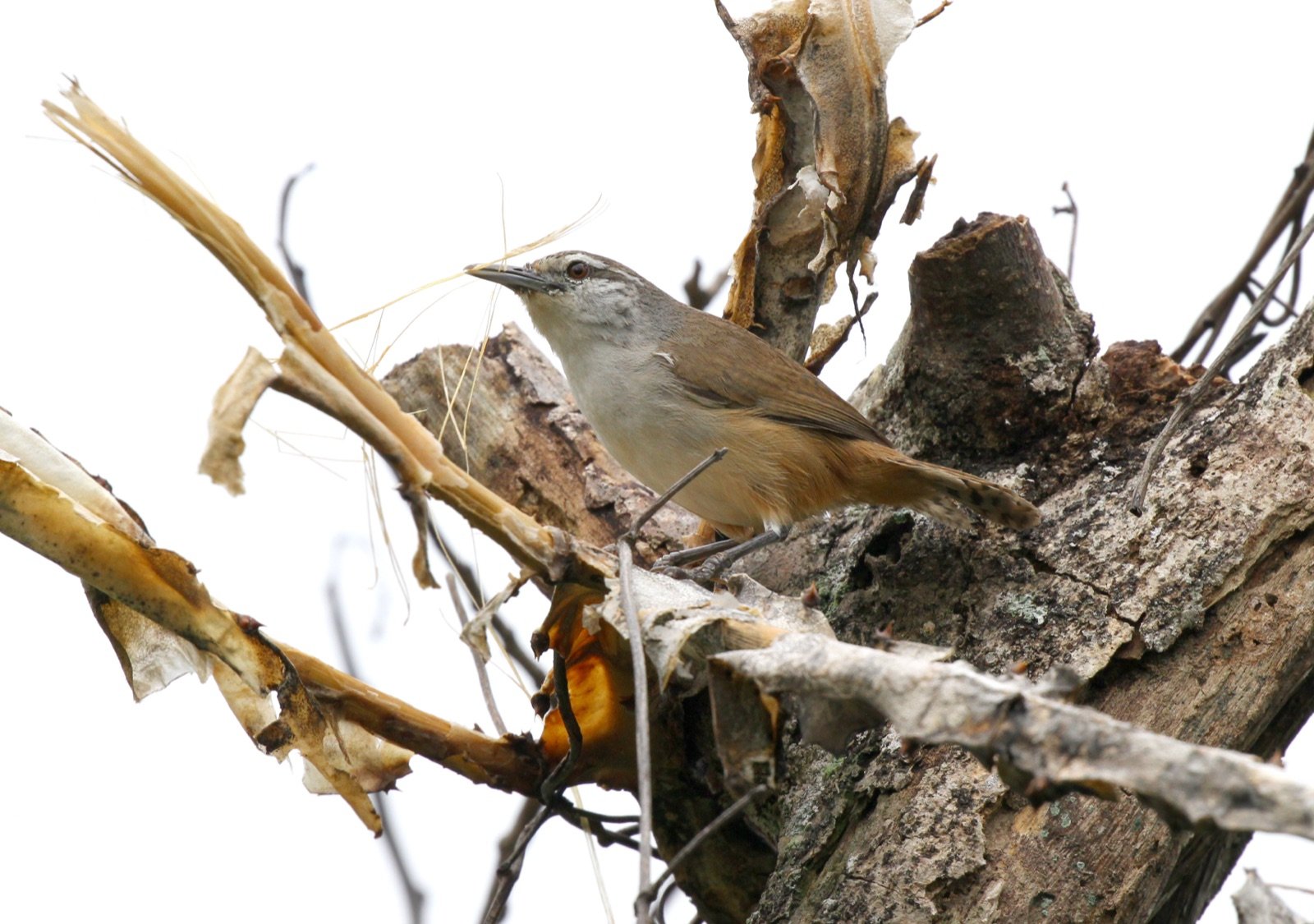
 Isthmian Wren
Family Troglodytidae
Isthmian Wren
Cantorchilus elutus
In Spanish: Soterré de Panamá
- Resident
- Regional endemic
A small, plain wren of the southern Pacific slope, best found by its whistled song.
The Isthmian Wren (Soterré de Panamá) is a regional endemic, found only in southwestern Costa Rica and Panama, so its overall range is fairly small. In Costa Rica it lives on the southern Pacific slope, and the range starts near San Isidro de El General in San José Province before continuing south and east into Panama.
It is not a showy bird. It has few obvious field marks, and it is a skulking wren that is heard more often than seen. Learn the song first and you will find it much more easily.
Costa Rica holds only the western end of its range, so the southern Pacific is where to meet a bird that barely reaches our country.
How to find it
Learn the song before you go, because the bird is far easier to find by ear than by eye. Look at forest edges, regrowth, leafy gardens and citrus plantations rather than inside dense wet forest. Be patient where you hear it, since a skulking wren may stay hidden and then sing out in the open. On one southern Costa Rica birding tour, a bird sang boldly in the open one afternoon near the hamlet of La Gamba, so scan exposed perches too. Another tour found one hopping in a roadside bush at Coto 47. On a trip we build through the south, the Pacific slope is where to look.
How to recognise it
This is a small wren, about 13 cm long. Look for these marks:
- Upperparts brown, flanks buffy.
- Throat, breast and eyebrow stripe white.
- Belly whitish.
- Eye red.
It has few obvious field marks, so it is easy to confuse with its close relatives. Eye colour needs care, because one Costa Rican description calls the Isthmian yellow-eyed, so check it in good light. Birds seen east of central Costa Rica should be Isthmian Wren, which has duller colours than Cabanis's Wren. One Costa Rican guide describes it as the Pacific-side version of the Plain Wren.
What it sounds like
Behaviour and diet
This is a skulking wren that is heard more often than seen, and both sexes sing often. It builds two kinds of nest. A thin, cylinder-like nest is used for roosting, while a sturdier elliptical nest with a downward-facing entrance is used for breeding. The breeding nest is built of grass and plant fibers, roughly football-shaped with a side entrance, and is usually placed within about 3 m of the ground in dense vegetation. It adapts well to altered habitats, so it can turn up close to people rather than only in remote forest.
Where it lives
The Isthmian Wren lives in humid areas, including forest edges, second growth and gardens, and it avoids dense wet forest. Across its range it is described as common or abundant. It uses regrowth, leafy gardens and citrus plantations with epiphytes. Its elevation range runs from sea level to about 2,000 m. In Costa Rica it lives on the southern Pacific slope, from near San Isidro de El General southward, and it has been recorded in the southern lowlands as well as near San Vito in Coto Brus.
When to see it
In Costa Rica it nests from January to September.
Similar birds
Cabanis's Wren, Canebrake Wren and Isthmian Wren were once treated as one species. Genetic work showed they are separate, and their songs also differ. Cabanis's Wren has a dark orange eye and lives on the northwestern Pacific coast of Costa Rica, where the two may now be meeting because of deforestation. Canebrake Wren has a greyer back, paler flanks and is slightly larger. It lives in eastern Costa Rica, so it does not overlap with the Isthmian's southern Pacific range.
Names and lore in Costa Rica
In Costa Rica the Spanish name is Soterrey de Panamá. Panamanians call it Sotorrey Istmeño, and a general Spanish name is Cucarachero del Istmo. Costa Rican names for the whole Plain Wren group include Soterrey chinchirigüí.
Status and conservation
The AOCR list marks it as a resident endemic (R-END), found only in southwestern Costa Rica and Panama.
How we know this 14 sources, each read on the date shown
- Wikipedia (Spanish) read 2026-11-04
https://es.wikipedia.org/wiki/Cantorchilus_elutus - Cloudbridge Nature Reserve bird list read 2026-11-04
https://www.cloudbridge.org/wp-content/uploads/2020/04/Bird-Species-List-Costa-Rica-13-April-2020.pdf - Wikipedia read 2026-11-04
https://en.wikipedia.org/wiki/Isthmian_wren - Birds of the World (Cornell) read 2026-11-04
https://birdsoftheworld.org/bow/species/istwre1/cur/introduction - Birds of Costa Rica (birdsofcolombia.org) read 2026-11-04
https://www.birdsofcolombia.org/costarica/Cantorchilus.html - Wikipedia mirror (Wikizero) read 2026-11-04
https://wikizero.com/www//Isthmian_wren - Field Guides trip list, Costa Rica Deep South 2023 read 2026-11-04
https://fieldguides.com/triplists/cr123.html - BirdForum Opus read 2026-11-04
https://www.birdforum.net/opus/Golfo_Dulce_Forest_Reserve - BirdForum Opus read 2026-11-04
https://www.birdforum.net/opus/Isthmian_Wren - Field Guides trip list 2018 read 2026-11-05
https://fieldguides.com/triplists/cr118.html - Exotic Birding Osa Peninsula checklist read 2026-11-05
http://www.exoticbirding.com/costarica/osa-peninsula/checklist.html - OTS Las Cruces Amigos newsletter read 2026-11-05
https://tropicalstudies.org/wp-content/uploads/2020/06/amigos_JUN2020.pdf - Birding Craft read 2026-11-05
https://birdingcraft.com/wordpress/2016/07/20/where-to-see-the-new-species-on-the-costa-rica-bird-list/ - Avibase read 2026-11-05
https://avibase.bsc-eoc.org/species.jsp?avibaseid=49CAF311