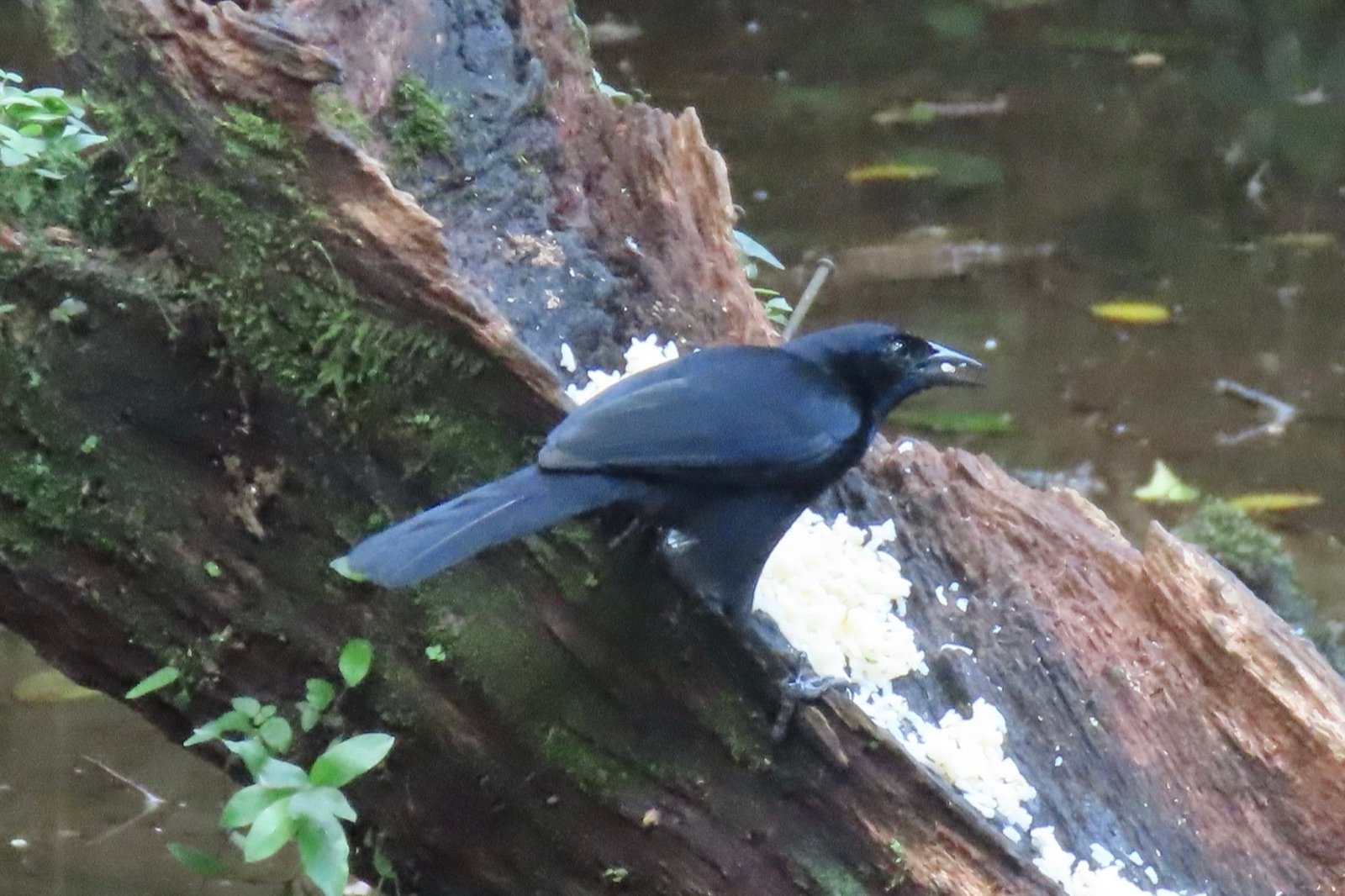
Family Icteridae
Melodious Blackbird
Dives dives
In Spanish: Tordo Cantor
- Resident
All-black, dark-eyed songster of lawns, gardens and field edges.
The Melodious Blackbird (Tordo Cantor, Dives dives) is the only all-black icterid in Costa Rica. Adult males show a strong blue gloss, and the dark eye is the quickest way to separate it from a grackle.
It is a newcomer. It was first recorded in Costa Rica in March 1987 and spread widely from the 1990s, and a 2007 field guide calls it widespread and fairly common.
It avoids dense forest and has adapted to people, so on a trip we build, lawns, gardens and town edges are the places to start.
How to find it
Start in towns, gardens and parks, where it is common and walks on lawns while foraging. It is only rarely seen inside big forest, so do not search the deep interior. Along field edges, pastures and creek sides, watch for a black bird bobbing its head at each step and flicking its tail. Pairs are most often seen perched together at the top of a tree in edge habitat, which makes them easy to find and watch. Listen first, since the ringing duet often leads you to the singers.
How to recognise it
Look for a hefty black bird, built like a large thrush, with an all-black looking eye. The bill is cone-shaped, sharp and pointed, and longer than a cowbird's. The tail is medium length, rounded, fairly broad and rectangular. The eye is dark brown, and the bill, legs and feet are black.
Adult males are black with a strong blue gloss and about 25.5 cm long. Females are about 23 cm and look like males but duller and browner. Young birds lack the glossy sheen. Sunny light helps show the colour.
What it sounds like
Recording: Arthur de Jesús Chavarría Pérez, CC BY 4.0, source, read 4 Nov 2026.
Behaviour and diet
On the ground it walks bobbing its head, picking up insects and sometimes flipping leaves or small stones. It often flicks its partly spread tail up and down. It also gleans caterpillars from foliage, often hanging awkwardly from twigs, and sometimes unrolls leaves by opening its bill inside them. It drinks nectar, especially from balsa trees.
It usually lives in pairs, though small groups of about 6 to 8 birds form, and it may join flocks of Groove-billed Anis (tijos). A calling pair puffs up, stands stiff and ruffles its feathers, then sings in turn while pumping on its legs. Breeding birds are very territorial and will attack predators such as the Brown Jay.
Where it lives
This is a bird of semi-open to open country in the tropical and lower subtropical zones, reaching 2,100 m in Costa Rica. It avoids dense forest and thick undergrowth, and it turns up in gardens and on lawns.
A 2007 field guide maps it in most of the country, except the southern Talamanca mountains. Older text puts it in the dry north Pacific south to Tárcoles, and it has been reported in the western Central Valley, Cartago and along the Pacific coast south to Quepos.
Similar birds
People often lump it with the Great-tailed Grackle as a zanate. The grackle is bigger, with a pale eye and a different song and calls, while the blackbird has a dark eye. Bronzed Cowbird and Groove-billed Ani are two more black birds that are easy to mix up with it. Shape helps, since the blackbird is hefty with a sharp pointed bill and a rectangular tail.
Names and lore in Costa Rica
The Costa Rican common names given for it are Pius and Tordo Cantor. Elsewhere in its range it is also called a smaller grackle (zanate menor) and is often mistaken for a zanate.
Status and conservation
The AOCR list marks it as a resident (R), and IUCN rates it Least Concern with a population believed to be increasing.
Photography tips
Pairs are most often seen perched together at the top of a tree in edge habitat, which makes them easy to find and watch. The shiny blue gloss shows best in sunny light, so shoot with the sun behind you.
How we know this 19 sources, each read on the date shown
- Flickr (Aves de Costa Rica natural history text) read 2026-11-04
https://www.flickr.com/photos/jobando/28409584116 - Aves de Costa Rica read 2026-11-04
http://www.avesdecostarica.com/Dives-dives.html - Kiwifoto (Wikipedia-derived species info) read 2026-11-04
https://www.kiwifoto.com/galleries/birds/melodious_blackbird/ - EcoRegistros (Wikipedia text) read 2026-11-04
https://www.ecoregistros.org/sheet/Dives-dives - HBW Alive / Internet Bird Collection read 2026-11-04
https://www.hbw.com/ibc/species/melodious-blackbird-dives-dives - UNED Biosonidos read 2026-11-04
https://biosonidos.uned.ac.cr/?q=node/262 - Pajareando ando read 2026-11-04
https://pajareandoando.com.mx/tordo-cantor-dives-dives/ - Bellas Aves de El Salvador read 2026-11-04
http://bellasavesdeelsalvador.blogspot.com/2015/08/dives-dives-tordo-o-zanate-cantor.html - Wikipedia read 2026-11-04
https://en.wikipedia.org/wiki/Melodious_blackbird - Aves de Costa Rica read 2026-11-04
https://www.avesdecostarica.com/Dives-dives.html - Ecos del Bosque (citing Stiles and Skutch 2007) read 2026-11-04
https://ecosdelbosque.com/fauna/dives-dives - Observadores de aves UNED read 2026-11-04
https://observadoresdeavesuned.wordpress.com/ - Animalia.bio (from Wikipedia) read 2026-11-04
https://animalia.bio/melodious-blackbird - UNED Biosonidos read 2026-11-04
https://biosonidos.uned.ac.cr/node/1424 - Birding Craft read 2026-11-04
https://birdingcraft.com/wordpress/2010/06/15/four-common-black-birds-of-costa-rica/ - Kiddle read 2026-11-04
https://kids.kiddle.co/Melodious_blackbird - Birding Craft read 2026-11-04
https://birdingcraft.com/wordpress/2021/11/24/which-bird-vocalizations-to-study-for-birding-in-costa-rica/ - Jim Conrad's Naturalist Newsletter read 2026-11-04
https://www.backyardnature.net/yucatan/blackbrd.htm - UHart Ticos blog read 2026-11-04
https://uhartticos.wordpress.com/2016/01/08/melodious-blackbird-danielle-d/