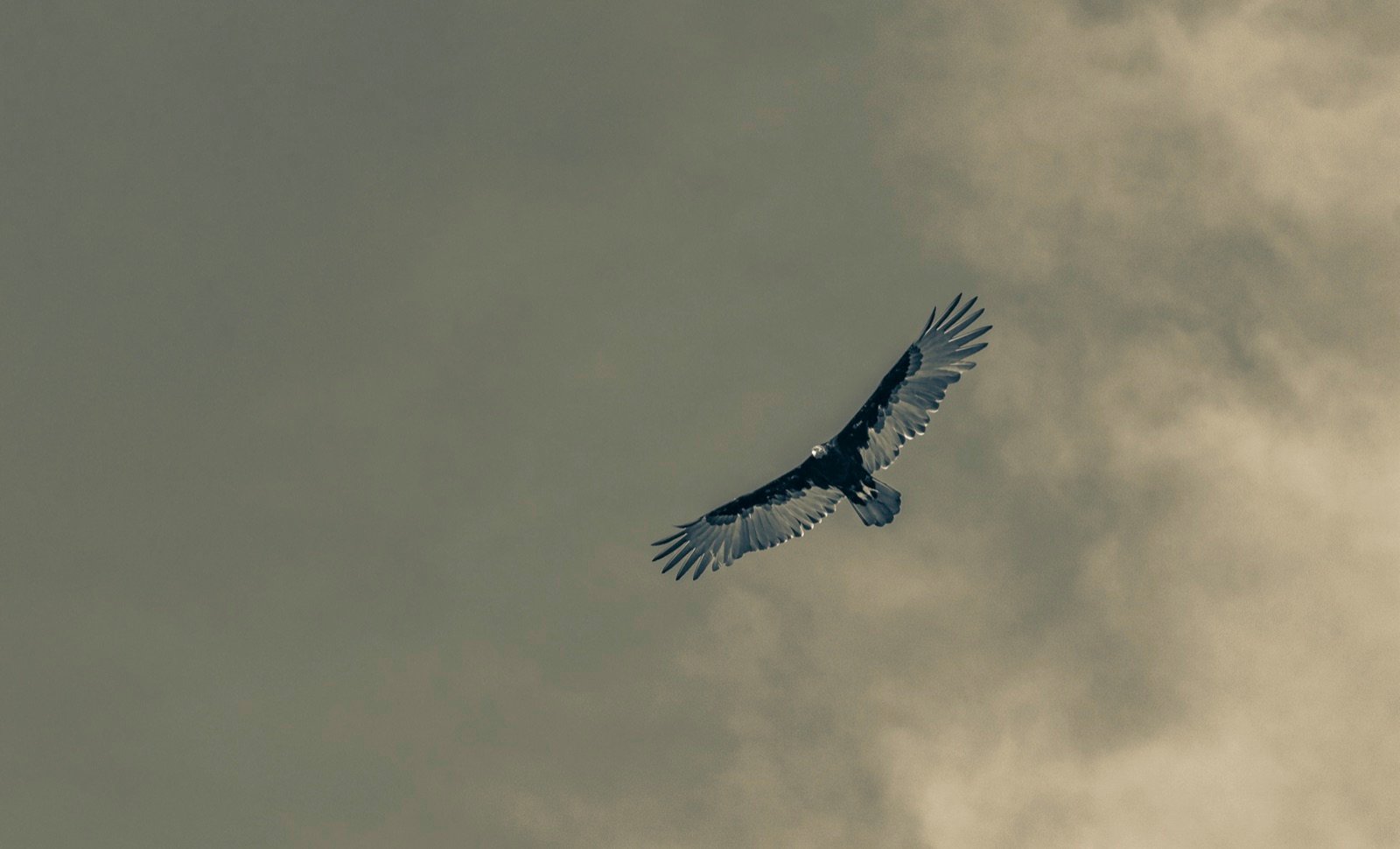
 Turkey Vulture
Family Cathartidae
Turkey Vulture
Cathartes aura
In Spanish: Zopilote Cabecirrojo (Zonchite, Noneca)
- Resident
A red-headed soarer you can spot on almost any drive.
The Turkey Vulture (Zopilote Cabecirrojo) is one of the easiest birds to start with in Costa Rica. You can hardly spend a day here without seeing vultures soaring overhead, so look up on any drive.
The resident race is common throughout the country, though far less numerous than the Black Vulture. Learning to tell the two apart is a small first lesson in reading a bird by its flight.
Once you know that it holds its wings in a shallow upward V and rocks from side to side while soaring, you can pick it out long before you see a red head.
How to find it
Look up on any drive, since vultures are overhead on nearly every day in Costa Rica. Check the beaches, where it is especially common and feeds on dead fish and other sea life washed ashore. Watch for the shallow V and the side to side rocking to separate it from the Black Vulture. If vultures gather at a carcass, scan the group for a red head. On a trip we build, the Caribbean lowlands near Puerto Viejo are the place to see migrants passing in numbers.
How to recognise it
Adults look blackish brown with a small, bare red head and an ivory bill. In good light the underside of the flight feathers looks silvery gray against darker wing linings.
In Costa Rica the resident birds have a bluish-white band across the back of the neck. North American migrants lack this band, so it helps you work out which kind you are watching.
Young birds look different. They have a blackish head and a black bill. The bare head skin turns gray and then pink as the bird ages, and the bill becomes ivory over about two years. A dark-headed bird with a black bill is a youngster, not another species.
What it sounds like
Behaviour and diet
Look for the flight first: wings held in a shallow upward V, rocking from side to side while soaring. Unlike many other vultures, it finds food by smell. It searches by flying low enough to catch the gases from newly decaying animals, and it also watches the ground and other scavengers. Black Vultures often follow Turkey Vultures to carcasses because of this.
It eats almost only carrion, prefers recently dead animals, and roosts in large groups. In courtship, several birds gather on the ground and hop in a circle with wings partly open.
Where it lives
Across its range it lives in open and semi-open areas, including subtropical forest, shrubland, pasture and desert. In Costa Rica it occurs across the country, from the dry Pacific coast to the Caribbean lowland rainforest. The resident race is common throughout. Large numbers of northern migrants pass over the Caribbean lowlands near Puerto Viejo in hawk migrations, and wintering migrants stay mainly in the lowlands.
When to see it
North American migrants pass through Costa Rica in the first part of the year on their way north, mostly over coastal lowlands. They start heading back north as early as February, most leave between March and early April, and stragglers can linger until May.
Similar birds
Black Vulture is slightly smaller and more aggressive. It hunts by sight only and flaps often with broad, plank-like wings. Yellow-headed vultures have yellowish or orange heads, often darker plumage, wings reaching past the tail tip when perched, and white primary shafts from above. The Lesser Yellow-headed Vulture is usually pushed away from carcasses by larger birds, including this one, and shows a yellow head with a reddish forehead and nape.
Names and lore in Costa Rica
Costa Ricans call it zopilote, gallinazo, chulo or golero, as well as the AOCR name zopilote cabecirrojo. Zonchiche is also listed as a common name. The word zopilote is also used for the Black Vulture.
Status and conservation
The AOCR lists it as a resident and migrant (R,M), and the IUCN rates the species Least Concern with a very large global population.
How we know this 15 sources, each read on the date shown
- Cornell Birds of the World read 2026-11-04
https://birdsoftheworld.org/bow/species/turvul/cur/identification - Birds for Beer read 2026-11-04
https://birdsforbeer.com/2016/03/04/turkey-vulture-migration-over-san-antoniomigracion-del-zopilote-cabecirrojo/ - Costa Rica Insights read 2026-11-04
https://costaricainsights.wordpress.com/2013/01/29/costa-ricas-vultures-so-prevalent-they-could-be-the-national-bird/ - Birda read 2026-11-04
https://app.birda.org/species-guide/8061/Turkey_Vulture - Wikipedia read 2026-11-04
https://en.wikipedia.org/wiki/Turkey_vulture - Birds for Beer read 2026-11-04
https://birdsforbeer.com/2013/08/22/vultures-a-stroke-of-luck/ - Wikipedia read 2026-11-04
https://en.wikipedia.org/wiki/Cathartes - Cornell Birds of the World read 2026-11-04
https://birdsoftheworld.org/bow/species/turvul/cur/humanrelation?lang=es - Ecos del Bosque read 2026-11-04
https://ecosdelbosque.com/fauna/cathartes-aura - Hawk Mountain survey paper read 2026-11-04
https://www.hawkmountain.org/download/?id=4948&dl=1 - Hotel Rivel (Spanish-language bird page) read 2026-11-04
https://hotelrivel.online/planeadores-majestuosos-el-zopilote-cabecirrojo-de-costa-rica/ - Cornell Birds of the World read 2026-11-04
https://birdsoftheworld.org/bow/species/turvul/cur/movement - ECOSUR (El Colegio de la Frontera Sur) read 2026-11-04
https://www.ecosur.mx/cathartes-aura-el-carronero-que-equilibra-la-naturaleza/ - Oiseaux-Birds read 2026-11-04
https://www.oiseaux-birds.com/card-turkey-vulture.html - Spanish Wikipedia read 2026-11-04
https://es.wikipedia.org/wiki/Cathartes_burrovianus